True Blue Casino Licence, ACMA Record and Trust Signals
 Available in AU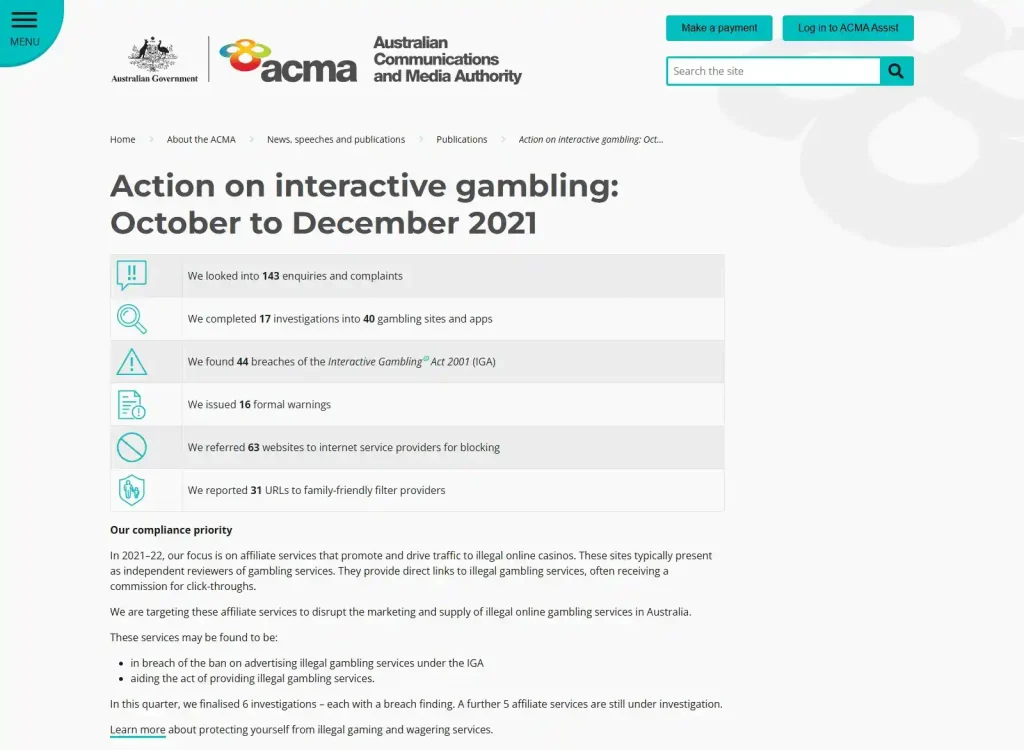
Licence and regulatory context
True Blue Casino is not shown as holding an Australian local licence. ACMA’s October-December 2021 enforcement report named True Blue Casino among services associated with prohibited interactive gambling supplied to Australians. Under the Interactive Gambling Act 2001, providers must not offer online casino services to people in Australia. That is a provider-side regulatory rule, not a basis for claiming that an individual Australian commits an offence merely by visiting or playing. Technical accessibility and Australia-focused marketing therefore need to be assessed separately from licensing and consumer-protection coverage.
Table of Contents
- The short answer on Australian licensing
- What ACMA recorded about True Blue Casino
- How Australian law treats online casino services
- Technical access is not the same as legal availability
- What the Australian licence register can and cannot tell you
- BetStop and the National Consumer Protection Framework have a defined scope
- Australia's 2026 reforms and the 1 January 2027 checkpoint
- Trust signals worth more than a licence badge
- Three regulatory signals answer three different questions
- A domain change does not settle brand continuity
- Why 1 January 2027 is a recheck date, not a shortcut
- What ACMA's record means when assessing True Blue Casino in Australia
The short answer on Australian licensing
True Blue Casino is not shown as holding an Australian local licence. That matters because Australian-licensed wagering services sit inside a specific regulatory and consumer-protection framework, while offshore online casino services do not gain that status simply because an Australian visitor can reach them.
Offshore licence claims for True Blue should be treated separately from Australian licensing. Without a current regulator entry and licence number tied to the operator, an offshore badge does not establish Australian local status.
For ordinary feature questions, such as payment methods or bonuses, see the dedicated payment methods and bonus terms pages. Licence status should not be used to invent facts about unrelated casino features.
What ACMA recorded about True Blue Casino
ACMA’s report covering October to December 2021 is specific. It says the regulator completed investigations into multiple gambling sites and apps and found breaches of the Interactive Gambling Act. In the enforcement section, ACMA named several providers in connection with prohibited interactive gambling services supplied to Australians, and True Blue Casino was one of the casino names listed under Netsurf Media S.A., Tabella s.r.o. and First Class Media.
The same report lists toptrueblue.com among websites referred for blocking during that quarter. That 2021 record applies to the service and period named in it; it does not establish that every current True Blue domain is identical to the one recorded then. It remains directly relevant to the brand’s Australian regulatory history.
How Australian law treats online casino services
The Commonwealth framework is the Interactive Gambling Act 2001. ACMA’s current guidance says the Act makes it illegal for gambling providers to offer certain online services to people in Australia, and it explicitly includes online casinos among the banned services.
That wording is important. The prohibition is framed around providers offering the service to people in Australia. That provider-side prohibition should not be turned into a broader statement that an individual player commits an offence merely by accessing an offshore casino.
ACMA also states that prohibited services must not be advertised in Australia. The regulator can investigate services, issue warnings and use website blocking as one enforcement tool. Its current blocked-sites material explains that online casinos and online slot-machine services provided to customers in Australia can be targeted under this framework.
Technical access is not the same as legal availability
An offshore site may still load in Australia, accept an Australian-looking registration flow or display AUD. None of those facts creates an Australian licence. Offshore casino-style services can remain technically accessible even where providers are not permitted to offer them to Australian residents.
This distinction is useful when comparing casino claims. “Works from Australia” can describe a technical observation. “Licensed in Australia” is a regulatory claim that should correspond to an entry in the relevant Australian register. Those two statements are not interchangeable.
The same distinction applies on the account verification page: a working account page tells you something about access, not about the legal status of the provider.
What the Australian licence register can and cannot tell you
ACMA directs consumers to a register for checking whether wagering services are licensed to operate in Australia. Current ACMA enforcement notices repeatedly remind users that services which look legitimate may still lack Australian customer protections.
True Blue Casino is not shown as holding an Australian local licence. It should therefore not be treated as covered by Australian wagering licence protections, Australian dispute-resolution arrangements or the minimum safeguards that apply specifically to Australian-licensed wagering providers.
Be cautious with broad phrases such as “fully licensed for Australians” unless they identify the Australian regulator, licence holder and register entry.
BetStop and the National Consumer Protection Framework have a defined scope
BetStop is Australia’s National Self-Exclusion Register for Australian-licensed online and phone wagering providers. Registering with BetStop is important for people who want to exclude themselves from services within that system, but it should not be assumed to block every offshore online casino account.
Australia’s National Consumer Protection Framework likewise sets minimum safeguards for Australian-licensed online wagering. Those safeguards should not be represented as automatic protection for an offshore casino account that is not part of the Australian licensing system.
If gambling is becoming difficult to control, Gambling Help Online and the National Gambling Helpline on 1800 858 858 provide free, confidential 24/7 support in Australia.
Australia’s 2026 reforms and the 1 January 2027 checkpoint
ACMA says the Australian Parliament passed major gambling reforms in August 2026. The reforms include tighter advertising restrictions, a global advertising opt-out register, restrictions on some direct-marketing inducements, limits on activity-based commissions and stronger enforcement powers. ACMA’s current guidance says most of these reforms commence on 1 January 2027.
For a page like this, that date is a freshness checkpoint. The position described here is current to September 2026. After 1 January 2027, readers should recheck the ACMA guidance because commencement of the reforms can change the details of enforcement, advertising and consumer-protection obligations.
Trust signals worth more than a licence badge
When assessing True Blue, start with verifiable records rather than decorative trust seals. A regulator entry, a dated enforcement notice and clearly stated terms carry more weight than an image saying “licensed” without a register link.
| Signal | How to interpret it |
|---|---|
| Australian licence register hit | Shows local licensing when the operator and service match the register entry. |
| ACMA enforcement record | Shows the regulator’s historical finding or action for the period named. |
| Offshore licence badge without register entry | Insufficient on its own to establish current licence status. |
| AUD, Australian spelling or local imagery | Shows market targeting, not Australian regulatory approval. |
| Website loads from Australia | Shows technical access only. |
This approach also keeps feature analysis in its proper place. A site’s games, payment methods or bonus structure can be assessed separately without turning licence uncertainty into a blanket statement about every part of the product.
Three regulatory signals answer three different questions
An Australian licence-register entry, an ACMA enforcement record and an offshore licence claim are not interchangeable. A matching Australian register entry would answer whether a service is licensed inside the Australian wagering framework. The 2021 ACMA record answers a historical enforcement question: it shows that True Blue Casino was named in regulatory action connected with prohibited interactive gambling services supplied to Australians. An offshore licence claim would answer a different question again and needs confirmation from the relevant regulator before it should be treated as current fact.
Keeping those signals separate prevents a common shortcut. An offshore badge does not become an Australian licence, and the absence of an Australian licence does not by itself prove which offshore entity operates a current domain. Likewise, a historical ACMA record applies to the service and period named in it, but it should not be stretched into a claim that every later site using the same brand has identical ownership.
For an up-to-date check, use the Australian register and ACMA guidance for Australian status, the dated ACMA material for historical enforcement, and the relevant regulator register for any offshore licence claim.
A domain change does not settle brand continuity
The 2021 enforcement material names True Blue Casino and records a specific website in the blocking context. A current True Blue-branded domain can therefore raise two separate questions: whether it is connected to the historical operation, and what regulatory status applies to the entity operating it now. One question cannot safely be answered from the other.
A different domain does not erase the historical ACMA record, because that record describes what the regulator found at the time. At the same time, the historical record alone does not prove that a newer domain is operated by the same company. Current operator details, terms and regulator records are needed to establish present-day continuity.
This distinction matters when looking at older casino information. Historical reputation, payment descriptions or licence badges can belong to an earlier operating setup. For trust checks, date and entity matching matter as much as the brand name printed at the top of the page.
Why 1 January 2027 is a recheck date, not a shortcut
The announced commencement of most 2026 reforms on 1 January 2027 creates a clear date for rechecking ACMA guidance. It does not automatically rewrite the historical 2021 enforcement record, create an Australian licence for True Blue or resolve conflicting offshore licence claims. Those questions still need to be checked separately.
What can change is the current regulatory guidance around advertising, enforcement and consumer-protection obligations. After the commencement date, the responsible approach is to read the updated ACMA material and legislation rather than carrying the September 2026 wording forward unchanged. Treat the date as a maintenance checkpoint for the legal context, not as a prediction about the casino itself.
What ACMA’s record means when assessing True Blue Casino in Australia
Related detail: full review.
The Australian regulatory position has three clear elements: True Blue Casino is not shown as holding an Australian local licence; ACMA named True Blue Casino in its October-December 2021 enforcement report; and ACMA guidance says providers must not offer online casino services to people in Australia.
Those facts support a cautious assessment of regulatory protection without overstating what the law says about individual players. They also explain why technical access, AUD presentation or a functioning login should never be treated as proof of Australian licensing. If you are considering an account, pair this regulatory context with the account verification guide and check the current position again after the 1 January 2027 reform commencement date.